Reading Shelley in 2026
Percy Bysshe Shelley has been a mainstay of the literary and aesthetic culture of the British Left since the poet’s own lifetime with the publication of pirated copies of Queen Mab in 1821 by Richard Carlile. This is a trend that continues to today as, for instance, I have quoted his poetry at every demo I have spoken at. Additionally, there are certain important similarities between his time and ours that I would like to elucidate which seem particularly pertinent with the release of five of the Filton 24. I would like to offer a brief overview and an analysis of where the situation went for Shelley, where we might be going and how Shelley’s ‘Popular Songs’ may be useful for us.
Shelley was born in 1792, three years into the French Revolution and a month and a half before the foundation of the first French republic. He seems always to have been a political radical, reading William Godwin, Thomas Paine and Mary Wollstonecraft voraciously. Paul Foot, in his seminal work ‘Red Shelley’, calls Shelley a Leveller, after the faction of Cromwell’s army, which as a characterisation is not the whole picture but is not inaccurate. He was famously expelled from University College Oxford in 1811 for the first piece of atheistic literature published in English, the pamphlet The Necessity of Atheism. From there, he would go on to live a near nomadic life across Europe and Britain, never settling for long, and drown in 1822 in the Gulf of La Spezia. Shelley’s life was defined by his politics: trying his hand at organising in Ireland, constantly on the run from Home Office spies in England and writing his critique of the present state in verse and fragments of prose. His writings were unpublishable in his lifetime for their ‘seditious’ content, which mostly meant anything that challenged the power of the church and/or the government. The administration of Lord Liverpool, terrified of an English uprising like that of the French Revolution, had suspended most civil rights, such as Habeas Corpus, and, more importantly for this discussion, restricted the freedom of the press drastically. The previously mentioned Richard Carlile, a publisher who may have corresponded with Shelley, and Leigh Hunt, a publisher and friend of Shelley’s, had both been imprisoned for their publication of what was deemed seditious, blasphemous pieces like Thomas Paine’s The Rights of Man. Most publishers did not themselves want to suffer for the sake of Shelley’s poetry particularly as from 1818 onwards he was writing in, safe and self-imposed, exile in Italy.
But then came the events of August 1819. At St Peter’s Field in Manchester, a crowd of perhaps as many as 100,000 gathered to demonstrate to demand the right to vote. The crowd had drawn many women and children, a majority according to some accounts. Just as Henry ‘Orator’ Hunt was taking the stand to speak, the demonstration was charged by the Royal Manchester and Salford Yeomanry. 18 were murdered and hundreds injured. This, and other responses of the government to rising British radicalism, had a drastic effect on British political life, to discuss the full length and breadth of which would take us beyond the scope of this essay. It must suffice to say that the massacre sent shockwaves through the political life of Britain. The Prince Regent, later King George IV, and Prime Minister Lord Liverpool both lauded the soldiers who had charged and killed the demonstrators. This praise for the soldiers along with the outcry from the public and press led directly to the so-called six acts, which strengthened the hand of the government to crackdown with the radical working-class movement. Part of this involved the Criminal Libel Act, which changed the lack of willingness to publish Shelley’s writing into a certain prison sentence for any publisher brave enough.
Despite this, in the aftermath of Peterloo, Shelley wrote even more. Shelley found out about the Peterloo massacre some time in September 1819 – likely from Leigh Hunt’s The Examiner or a British expatriate newspaper from Paris called Gagliani’s Messenger. This began the most prolific period of writing in Shelley’s career. He either finished or began the following: Prometheus Unbound, Ode to the West Wind, and a collection of ‘Popular Songs’, as Shelley called them in a letter to Leigh Hunt in 1820. Which poems actually constitute the popular songs is hard to say for certain, but Susan Wolfson, writing in the Oxford Handbook, argues compellingly that the following poems should be included: Lines Written During the Castlereagh Administration, Song to the Men of England, The Mask of Anarchy, To Sidmouth and Castlereagh, What Men Gain Fairly, A New National Anthem, England in 1819 and The Ballad of the Starving Mother. There are a handful of definitions but Wolfson’s list forms a core to which others add. Jack Donovan, glossing the Longman Edition of Shelley’s poems, argues for all of the above in addition to Arise! Arise! Arise! and in Shelley’s Revolutionary Year, Paul Foot includes all of Wolfson’s list in addition to the prose fragment A Philosophical Vew of Reform, Ode to the West Wind and Ode to Liberty. Regardless of what Shelley intended to include in his definition of the popular songs, these poems written in response to the Peterloo Massacre can serve as part of the working-class movement’s agitational repertoire. This is not new to the working-class movement but an exploration of how Shelley was deployed prior to now falls outside the scope of this essay – in fact, it could constitute a whole volume. For a brief look at this, see Foot’s collection, Christopher Caudwell and the various mentions of Shelley in The Daily Worker.
It would be useful to read a couple of these popular songs closely before continuing. Song to the Men of England begins: ‘Men of England, wherefore plough / for the lords that lay ye low?’. In this line, Shelley says directly to the workers of England: why do you work for the people who oppress you? The poem as popular song when read aloud is a confrontation to its listener, written to expose the listener to the contradictions of his own economic life. This is the fundemental conceit of the popular songs, to talk directly to the working people of England, to address them by their concerns and meet them at their needs. It is this fundemental conceit as well as the content of the poems that allows Shelley to be brought into the struggle now and be just as poignant as he was in his own day. Later in the poem, Shelley asks: ‘Have ye leisure, comfort, calm, / Shelter, food, love’s gentle balm?’. In these lines, Shelley again begs the reader to question if any of the great pains they go to in their work have been worth it at all. Shelley asks as agitation, saying again: ‘What is it ye buy so dear / with your pain and with your fear?’ The poet highlights the inequality of the early capitalist social relations of 1819 and the emerging contradiction between the socialised nature of labour and the privatised nature of profit. The worker can only survive by selling through their pain, fear and toil – labour-power in a word. The narrative of the poem lays out that they have nothing to show for their work, for selling their labour-power in fear and by coercive necessity. The ‘Men of England’ in Shelley’s poem have nothing to show for all their work, not even a sense of calm. We must do as Shelley intended with his poems and inspire the whole working-class to question their conditions and call them to realise their place in the struggle. Song to the Men of England is perhaps the finest example of Shelley’s popular songs seeking to raise up the working-class and agitate for mass action.
Another of the popular songs that bears remarking on is the famous sonnet England in1819. In this poem, Shelley presents a critique to the structures of monarchy and heredity that maintain the hegemony of the coalition of classes that governed the British Empire – the arisocratic landholder and the industrial bourgeoise. The poem begins thusly: ‘An old, mad, blind, despised and dying King’. This is a clear allusion to King George III, who was King for every year but two of Shelley’s life. He had been incurably mad for a much of his rule and from 1811, the future George IV was ruling on his behalf. For Shelley, this was part of the absurdity of the Westminster system. The head of the church, the largest landowner in the country and the pinnacle of the aristocratic system was so mentally ill that he could not perform the duties of rulership he was meant to – the duties we were told, and are told still, make the rule of the monarch just. This highlighted to Shelley the arbitrary nature of aristocracy and monarchy, both Georges are those rulers who can ‘neither see nor feel, nor know’ the state of their country in their maddness and decadent detachment respoectively. This duty of royalty was an entitlement to power and to parastism on those who actually work, as Shelley begins in Song to the Men of England and develops here. We can feel this in Britain today. At a cinema I frequent, they always play an advert for ‘The King’s Trust’, a charity to combat youth unemployment. However, King Charles III is one of the largest landowners in England, one of the largest single landlords in Britain and now the brother and defender of a known pedophile. That connection is inextricable, the social relations that give rise to and maintain the monarchy are the same social relations that create the conditions for huge youth unemployment. Just about half of Cornwall’s youth are unemployed but the monarchy, Prince William is now the Duke of Cornwall, owns huge parts of that part of England. Shelley’s point stands and should serve as a pivot point of agitation against the current order of social relations in Britain. The poem deepens this critique by saying that the rulers ‘leech-like to their fainting country cling’, the aristocracy and monarchy exist in parasitic relations with the people. The key term in this line is ‘fainting’ which highlights the state of the nation. Here, Britain literally swoons under the weight of aristocratic oppression. The nature of this critique has not really changed at all, duchies and old aristocratic families are still some of the largest landowners in Britain, still stifling whole nations like Wales and Cornwall under the weight of their property portfolios. This has morphed however, it is not just duchies that cling to us like leeches but huge multinational holding companies that speculate on the houses we live in and extract rent from us like blood. With the present union of finance and industrial capital, Shelley’s critique takes on new form, both the remnant aristocratic forms and the new, bloody imperialist forms of rent crush us and in England in 1819, Shelley lays bear this injustice. The pinnacle of this is the sonnet’s turning point: ‘Golden and sanguine laws which tempt and slay; / religion Christless, godless – a book sealed’. In these lines, Shelley argues that it is what appears as the bedrock of the capitalist system that are causing this: the legal system and the established church. While this is itself a utopian socialist critique, blaming the correct superstructural formations but not uncovering the underlying relations of production like the poem does earlier or as Song to the Men of England does, it remains important as a point of articulation around which Shelley can be used for contemporary agitational purposes. If we can use Shelley to expose the contradictions of the bourgeois superstructure then we can lead the working-class’s eyes to the cracks in the base of capitalism-imperialism.
The reform or revolution message of the popular songs is clear, when taken in microcosm in Song to the Men of England or in reading the whole collection: capital is willing to kill you, kill it first. This has been made evident today with the recent hunger strikes by political prisoners on remand for actions carried out by Palestine Action. Five of these 24 were granted bail and released from prison, following being found not guilty on the 4th of February. From October last year, eight of the Filton 24, who were still on remand, held a hunger strike that only ended in January of this year with the government conceding on a handful of minor demands. The message is clear: capital wants you dead if you threaten it. This represents a similarity in the political composition of the Starmer and Liverpool Governments. Both were responsible for great suffering of political prisoners: direction actionists, and radical writers and publishers respectively.
This then facilitates drawing a parallel between the two governments in terms of class composition as well. Both governments, Lord Liverpool’s and Starmer’s, are representatives of their classes – the alliance of bourgeoise and aristocratic landholders and the bourgeoise and the proletarianising labour aristocracy respectively. The Yeomanry at Peterloo were the sons of rural landowners and Starmer is the servant of decaying empire, watching super profits slip through his fingers like sand. In both cases, we can see the death throes of an ally of the bourgeoise. Lord Liverpool governed Britain to maintain the dwindling power of the landed aristocracy and Starmer is presiding over the dissolution of the atlanticist imperialist bloc. Furthermore, the arrest of anti-government publishers and the mass arrest of pensioners at Defend our Juries protests mark a clear parallel between our time and Shelley’s. The footage of these protests can be likened to The Mask of Anarchy. We see pensioners with calm faces and police shoving bystanders to drag elderly men and women away, which recalls these lines: ‘Stand ye calm and resolute, like a forest close and mute’. Additionally, Home Secretary Castlereagh’s use of mass spy networks to weed out radicalism and Shabana Mahmood’s proposal for a panopticonic policing system, replete with AI, are a stark parallel. Both governments kept a watchful eye on their ‘trouble makers’ but only now is it so cold, robotic and unforgiving. Another interesting parallel is that at the start of the 1800s, the Duke of Norfolk, a prominent Member of Parliament, frequently toasted to a republic in Britain, two decades later advocating only the right to vote meant getting murdered. Two decades ago Shabana Mahmood would have been on the streets with us, now she oversees our arrests. In these two profiles, we can see the way capitalism aborbs critics like a sponge.
At Peterloo, the reformers met to demand the right to the vote and they were slaughtered for it. The hunger strikers have come so close to death that they could feel its breath and have all suffered life-long damage. These are just two moments where the face of capital shows. The true nature of the capitalist system’s coercion is unveiled, we are free but by necessity must submit ourselves to capital by selling our labour-power. Importantly, Shelley can serve as an important tool in unmasking the processes that give rise to moments like the treatment of the FIlton 24 and the Peterloo Massacre. His verse falls somewhere in the middle of the agitation-propaganda distinction and that is useful for us as we need to find ways to throw off the veil of ideology that hides capital’s tyranny and anarchy that have popular appeal. Shelley’s poems do this in stunning imagery and quotable verse throughout the popular songs. What Starmer does, and what Lord Liverpool did, in repression is use ideologies of ‘law and order’ or ‘seditious libel’ to obscure real class relations in language of decency and peace. Shelley uncovers the tyranny of bourgeois government and an anarchy of capitalist production, then and now, and he poses a challenge to the ideological structures that keep capitalist social relations hidden. In his popular songs, Shelley shows that this is not moral failing but baked into the foundations. The popular songs show capitalism as it is, shows that Peterloo was the aristocracy clinging to power like leeches, to paraphrase England in 1819, and that can be mobilised in today. Verse, when read aloud or alone, is a potent tool for conveying ideas and revolutionary verse such as Shelley’s is indispensable to us in the struggle. Revolutionary poetry is a means through which we can spread our ideas, highlight capitalist hypocrisy and agitate for a better future.
We can see and examine this idea of unveiling in Shelley’s poetry as well. This is most prominently featured in The Mask of Anarchy‘s first stanzas, where murder, fraud and hypocrisy are all dressed like three great men of state,: Lords Eldon, Sidmouth and Castlereagh. Murder ‘had a mask like Castlereagh’, Fraud ‘had on, like Eldon, an ermined gown’ and Hypocrisy ‘like Sidmouth’ rides on a crocodile and is ‘clothed with the bible, as with light and the shadows of the night’. This image of the chaos and tyranny of the present government being clothed with other, more palatable things is a vital agitational tool for Shelley. It points out that these things: religion as in Sidmouth, the law in Eldon’s Ermine Gown, or emotion as Sidmouth-hypocrisy weeps are defences against what is really going on: tyranny, murder, fraud, hypocrisy, and government by the capitalist class. This critique can be turned easily onto our great people of state today to highlight what people are already feeling: that bourgeois dictatorship is weakening and cracking under its own contradictions, its own hypocrisies. Shelley highlights not just that this is really happening but that we have the power to tear it down. In beginning The Mask of Anarchy with a statement on how capitalism masks itself in ideology, Shelley ends the poem with his most famous call to action: ‘Rise like lions after slumber / in unvanquishable number – / shake your chains to earth like dew / which in sleep are fallen on you – ye are many – they are few’. This is quintessential Shelley in the popular songs, grand imagery serving the sole purpose of inspiring uprising. Here Shelley looks the worker in the eye and unflinchingly asks: will you who are powerful together let this continue?
In using Shelley’s poems for agitation we can help to rectify two injustices: the great one of capitalism-imperialism and a small one, that Shelley wasn’t popular until after his death. It was not until after his lifetime that his poetry found truly mass appeal and it was not until after his death that his poetry was mobilised as I have argued it should be – in both cases with the Chartists. The contradictions of Shelley’s time sharpened and sharpened until rupture in 1832 and the Great Reform Act. This act expanded the franchise to the middle-classes: the shopkeepers, middle peasants and small landowners. Shelley’s poetry was not mobilised by these classes but by the working class who had fought for the act but were betrayed by it. Let the Great Reform Act be a warning that we have many more destructions to get through and when we are through we cannot accept any step forward but a great leap. The contradiction exposed by Shelley in the popular songs is unresolved, that resolution is our task as it was his. Independent working class political power is a solution Shelley could not have seen but we can mobilise his poetry for that purpose.
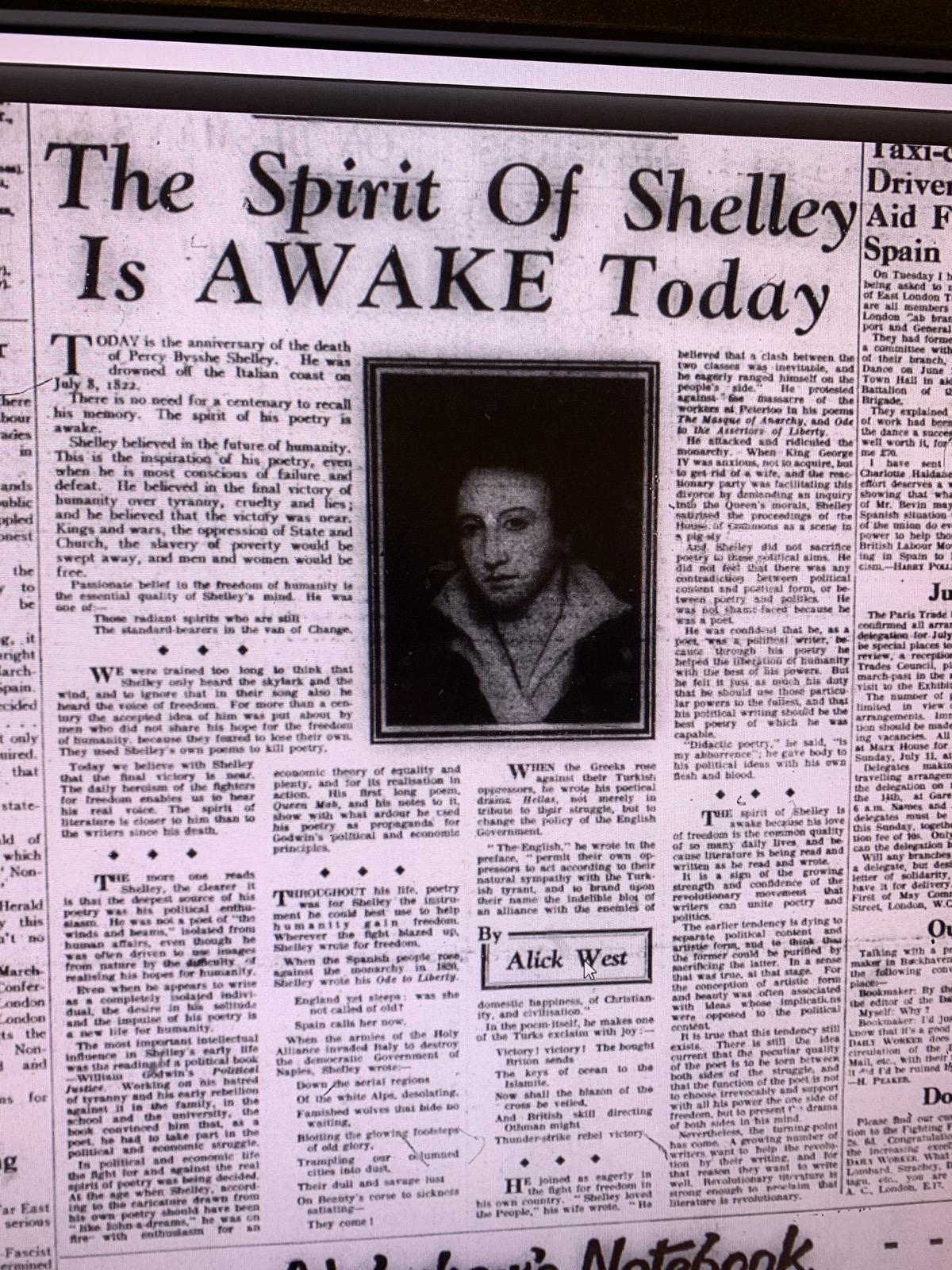
To conclude, I have proved the value that Shelley’s popular songs collection can have for communists in the modern day. The contradictions Shelley exposes remain essentially the same or similar enough in context for their deployment to shed light on our conditions and inspire people to act. I will end with the words of Alick West in The Daily Worker: ‘The Spirit of Shelley is awake today!’
– Steve, March 2026
Works Cited:
Bieri, James. Percy Bysshe Shelley: A Biography. Baltimore: Johns Hopkins University Press, 2008.
Foot, Paul. Red Shelley. Sidgwick and Jackson, 1980.
Foot, Paul. Shelley’s Revolutionary Year. Redwords, 1990.
Shelley, Percy Bysshe. Letters of Percy Bysshe Shelley. 2 vols. Oxford: Oxford University Press, 1964.
Shelley, Percy Bysshe. The Poems of Shelley. 3 vols. London: Pearson Education, 2011.
West, Alick. “The Spirit of Shelley Is Awake Today.” The Daily Worker, July 8, 1937.
Wolfson, Susan. “Popular Songs and Ballads: Writing the ‘Unwritten Story’ in 1819.” In The Oxford Handbook of Percy Bysshe Shelley, edited by Michael O’Neill, 341–359. Oxford: Oxford University Press, 2012.
Further reading:
Althofer, Jayson. “‘Trace Your Grave’: The Poetry of The Communist Manifesto‘s Grave-Digger Thesis.” TEXT: Journal of Writing and Writing Courses (July 2023): 2–15.
Borushko, Matthew. “Violence and Nonviolence in Shelley’s ‘Mask of Anarchy.'” Keats-Shelley Journal 59 (2010): 96–113.
Caudwell, Christopher. Romance and Realism. Princeton, NJ: Princeton University Press, 1970.
Connell, Philip. “‘A Voice from over the Sea’: Shelley’s Mask of Anarchy, Peterloo and the English Radical Press.” The Review of English Studies 70, no. 296 (2019): 716–731. https://doi.org/10.1093/res/hgz029.
Fischer, Michael. “Marxism and English Romanticism: The Persistence of the Romantic Movement.” Nineteenth Century Contexts 6, no. 1 (1982): 27–46.
Paley, Morton. “Apocapolitics: Allusion and Structure in Shelley’s ‘Mask of Anarchy.'” Huntington Library Quarterly 54, no. 2 (1991): 91–109.