Skip to content

Red Storm

  • Posts
  • About

Author: RedStorm

A response to ‘Notes on Fascism and Anti-Fascism’

Posted on February 2, 2026 - February 2, 2026 by RedStorm
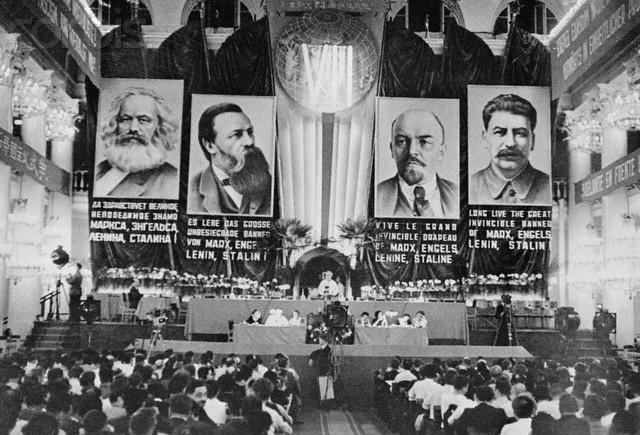
Photograph of the Comintern's 7th congress in 1935

This work is a critique of the position as expressed in the Notes on Fascism and Anti-Fascism (https://redstorm.noblogs.org/2025/11/67/) though I was not present for the discussion which produced these notes. There are many issues with the position as articulated. Some or all of what I write may be a response to the articulated position rather than the actual position, that will unfortunately be a consequence of my not being present for the discussion that produced the Notes on Fascism and Anti-Fascism. Further, I take issue with the way this position has emerged, seemingly not through the living, breathing, present struggle but rather from various disparate writings.

Issues of Methodology

There are some issues of method in the current collective understanding of fascism. To begin with, the position seems less an understanding of fascism and more a synthesis of three thinkers that comrades read and find persuasive. However, to investigate properly something as complex and important to our understanding of the current situation, we cannot simply take from the works of people who can make persuasive arguments. We must remember and internalise Oppose Book Worship, and I appreciate the irony but ask you to bear with me. We cannot think, as Mao caricatured book worshippers, that ‘Whatever is written in the book is right’ because this is ‘the mentality of culturally backward Chinese peasants’. Simply because Hammerquist can write it poetically or Sakai can write it acerbically, does not mean that it is true or that the analysis is sound.

    Furthermore, there has been an unjustified disregard for the lessons learned in the course of the struggle against previous fascisms. Most egregiously, the investigations and theoretical understanding of the Communist International are disregarded and framed in a disingenuous light. Fascism was not seen as a wing of the state but more akin to a crisis movement seeking to entrench and save bourgeois power when it seemed to come under threat. The militants of the Comintern are the voices that experienced the first fascist offensives and a proper understanding of them must be reached. To return to Oppose Book Worship, Mao identifies that to not have probed into the ‘present facts and past history’ of a situation means to not have investigated in the slightest. We must understand the past of anti-fascism and the lessons that they have learned in order to combat and understand fascism in the present. We have things to learn from G Dimitrov (this is not to say you should carry out Dimitrov’s recommendations on strategy and tactics) and R Palme Dutt, who spent decades fighting and understanding fascism. We cannot so stubbornly refuse to learn from them. If their conclusions are wrong, we will find that there conclusions are wrong by investigating fascism as it is reborn in front of us not by reading what other people have theorised about fascism. At the same time, it is inadequate to read only these figures of the first fascist offensives or to read both the new and the old. No book or theoretical work can contain the struggle.

    On a similar note, there appears to be a misunderstanding of the Comintern’s position on fascism. It was not seen in the slightest as ‘almost beyond capitalism’, it was seen as the sincerest face of capital. Fascism was not also seen as a wing of the state by any means. Fascism and social democracy were the right and left wings of capital, which is a reductive position in and of itself. The definition of fascism as the Comintern put forward is, to quote from a resolution from the seventh Comintern Congress in 1935: ‘the open terrorist dictatorship of the most reactionary, most chauvinist and most imperialist elements of finance capital’. While this definition has problems that it is beyond the scope of this piece to address, it is still a vastly more accurate definition. We can see that the Comintern believed fascism to be authentically capitalist, inexorably linked with imperialism as capitalism’s highest stage and fundamentally based in protecting capital which figures like Dutt go about proving. Additionally, the Comintern did not really advocate for alliances with just anyone who opposed fascism. The policy, misguided as it was from Dimitrov, was the creation of a united front of the revolutionary representatives of the industrial proletariat, i.e. trade unions, youth leagues, working-women’s organisations, upon which could be built a popular front of all anti-fascists who would stem from other classes. The popular front, of course, involved collaboration with social democrats, conservatives and liberals. This was and is only situationally useful and we should not right now engage in popular front work. In France though, for instance, their popular front ended up stabilising capital and I am sure its modern incarnation will too. In Germany, however, the popular front tactic may have prevented Nazism coming to power but this would likely have involved some form of compromise with reformist elements. 

    The solution then is to investigate fascism as it comes before us. To examine Nazism, Falangism, classical Fascism and the modern fascist offensive in terms of their history, their present class composition and what we can perceive of their strategy. We must come to an understanding of the class composition of past and present fascisms. One of the few ways to examine bullshit closely, however, is to sit in it. We must interrogate each fascist offensive in its entirety and inquire into its class composition by going into fascist spaces and understanding the material needs and conditions they are responding to. We must also examine fascism as a movement that seeks to be given, not take, state power. Hitler was handed the chancellorship when the votes of the Nazi party were declining. Mussolini’s “march” on Rome was a piece of political theatre: King Victor Emmanuel III had already given him the prime ministership and Mussolini arrived to Rome by train to coincide with the arrival of his marching foot soldiers. Fascism historically cannot be said to be revolutionary when the bourgeoisie give it power time and time again. Furthermore, the bourgeoisie do not often give power to anyone who will truly challenge their ownership of the means of production. This seems to continue to today with Trump becoming Statesian president in legitimate elections twice. State power is very rarely taken by fascists because fascism is an organ of the current order, i.e. the dictatorship of the bourgeoisie, and historically it is more likely to find itself given power. When liberalism needs to tap out, fascism taps in; democratic rights are curtailed and capital shows its true face. 

    Lastly, there doesn’t seem to really be an interrogation of the concrete social relations of fascisms past and present. The question as to the class composition of fascist movements remains unexamined in the Notes. The question of how fascisms function seems to have been reduced, in some quarters, to does a bad thing occur rather than looking at how fascism, by and large, has remade the supports around the dictatorship of the bourgeoisie in times when that dictatorship seems to lie on shaky ground. Palme Dutt says that this is the bourgeoisie seeking to head off proletarian revolution, a kind of mirror revolution to draw on C Caudwell, where fascism poses itself as revolutionary but rather strengthens and enshrines social relations. The goal of the revolutionary movement must be the abolition of these social relations.

Things without real issue

I do not entirely disagree with the Notes however. Below are some elaborations on the things that I do not find objectionable.

    The critique of the popular front as a long-term strategy is a fair and correct one, as I have touched on, we cannot compromise with reformist trends and wish to tear down the social relations that define capital. Additionally, working with any kind of reformist elements of the left and any liberals will always lead to the strengthening of capital and nothing more. Fascism is a defence mechanism, a knee-jerk reaction, to a crisis where capital might come under direct threat. We can’t work with capital’s other leg, the liberals and reformists, because it is part of the body of capital. We will be outnumbered by the liberals and the reformists and so to work with them is, in fact, to dilute ourselves. We must rather engage in mass work and work with revolutionary elements.

    Fascism is a system of fancy. If it is comparable to anything left-wing, it would be the utopian socialists in that they believe or rather profess to believe that their movement can and will meaningfully challenge the class system. In both cases, this is illusory and that recognition of fascism’s illusory promises is paramount. 

    Fascism is also undoubtedly rooted in machismo. It’s in every poster of the big aryan specimens standing very closely as compatriots. The big and capable aryan man who promises to smash bourgeois decadence but ends up licking bourgeois boots. Though I would argue this machismo enters into homoerotic territory, with male-male relationships being the only viable source of social capital as a woman is simply a piece of property by which you can make more workers and you can’t have a meaningful relationship with a piece of property, in the fascist conception. The illusory nature of fascism’s promises allows the machismo to coexist with alleged feminism, see TERFism and the pink ladies, fascism promises to ‘protect’ women as a political class but in actuality enshrines the social control of women by men.

    Broadly as well fascism is not really a conscious creation though when it arises it is more often than not consciously utilised. Fascism arises fairly organically, historically speaking. Falangism for instance has deep roots in the Catholicism of Spain and the institution of the Catholic Church has a rich and storied history of promoting authoritarianism in countries where it is the majority, even before the era of imperialism and the emergence of fascism, the two of which are inexorably tied. Before Nazism took power in Germany and well before the NSDAP was founded, there were a hundred, hundred small fascist, semi-fascist or proto-fascist organisations. There were the monarchists, there were the volkish nationalists, there were civic nationalists, there was Japanese-style militarism-fascism, there was the erstwhile enemy of Luxemburg and Liebknecht: the Freikorps. These movements arise in moments when bourgeois power seems fragile, the civil war in Spain or the long decade and a half of revolutions, putsches, failed soviets and street violence following WWI in Germany, and when one seems to find purchase as a mass movement, most others fade away. 

Issues with the conclusions

Firstly, fascism itself purports to being that revolutionary 3rd position described in the notes on fascism. I am deeply suspicious of any position that comes to the same conclusions about fascism that it preaches about itself. Why, pray tell, are we seeming to take fascism at its word? Much of what fascism purports to being and says it will enact are not really anti-capitalist measures but rather a trick, wool pulled over the eyes, to gain mass support. Nowhere has fascism sought to or actually has dispossessed the bourgeoisie of their power and always has fascism come to power with the explicit support of a least a section of the bourgeoisie that has then gone on to profit immensely from fascism’s gaining state power. For instance, in Nazi Germany the use of the slave labour of the ‘undesireable’ populations of Europe was prevalent and represents a transformation of our relation to the bourgeoise, but not a transformation of their relation to us or their relation to the means of production. The vampiric nature of capital hasn’t changed or lost the ability, power or position to feed off labour, it is simply that labour is kept in rather heavier chains than before. The concrete social relations were not upended, capital simply facilitated more efficient extraction of profit.

    I will concede that capital ceded some state power in the case of Nazi Germany however because capitalist social relations remained under Nazi rule then a transformation of the system cannot be said to have happened. It must be remembered that control and ownership are two incredibly different things. The Nazis undoubtedly strove for autarky but this looked in reality like working with large business concerns to direct them to gain more profit. At no stage of this process did ownership over the means of production change hands or did capital change its relation to labour. It is a rather analogous process to the process by which the labour aristocracy forms under the leadership of a reformist wing, for instance Britain in the post-war period throwing up the welfare state was a shield for capital against the workers’ movement strengthened during the war. The threat of proletariat revolution seems so imminent in a period of intense crisis that capital is left with two options, the mean one (fascism) and the nice one (reformism). Fascist anti-capitalism is about as sincere in its anti-capitalism as Social Democracy, by which I mean that they both are not. 

    Fascism is the ‘break in case of emergency’ of imperialism-capitalism when reformism seems impossible, revolution around the corner and capital must uplift a section of the dispossessed population to be its mercenaries and protect its power. To return to the instance of Nazi Germany, many of the brownshirts and SA came from a proletarian background while the leaders and members of the SS came from a petty bourgeois background, for example Adolf Hitler’s father was a tax collector in the Austrian Empire. On the SA, they were purged almost as soon as the Nazis took power because capital with it’s fascist face on does not suffer the organised proletariat uncontrolled and the SA were notoriously unruly. However, their promises of the rebirth of the nation with the elimination of decadent capitalism was false and was not borne out materially in the slightest. The big business concerns remained but it was only the Jewish CEOs who had their wealth expropriated. The most that happens under fascism is the uplifting of a handful of the dispossessed and downwardly mobile to the status of running dog.

    Secondly, the white working-class does not have really all that much to gain from fascism. Ideologically, it sure seems like it but fascism is always illusory, it is a mirror revolution that, in claiming to defeat capital, erects a wall and moat around it. Fascism obscures capital’s power behind notions of the race and the fatherland but keeps capital nice and safe. Race is often just the hat capital puts on to hide itself, to try to obscure class differences and keep itself intact. In the instance of Falangism in Spain, the Spanish people were all Spaniards, all Catholics under Falangism which said ‘you don’t need to do anything rash in front of The Holy Virgin, do you Mr Worker?’. Fascism heads off proletarian revolution by making running dogs of some of the dispossessed but the whole of the dispossessed cannot be lifted up at once and as a whole. There are only so many low-level bureaucrats and soliders that fascism needs and as a result fascism cannot challenge bourgeois power because to challenge bourgeois power means, necessarily, to seek the liquidation of class. This is the class basis of its constant drive to war, ideologically you must ‘fight for the fatherland!’ and materially the mercenary class of capitalism is strengthened and given purpose. Fascism must be a hive of activity, a frantic drumbeat. It must always be active, fighting this enemy or that, so as to give its running dogs something to chew on. Being imperialism’s running dog is all well and good, until you remember you are still a dog and start having the compulsion to get the fucking collar off. Fascism seeks to safeguard capital’s power by uniting any elements that could challenge it, telling those subversive, dispossessed elements that there’s a national rebirth that needs midwives not the birth of the communist world.

    Lastly, there does not seem to be a recognition of the mass work that is needed to combat fascism. There are brief mentions of an ephemeral left-right political basis but these are not classes who have concrete relations to the means of production. We must ask what are the classes we are mobilising? Who are they? Where are they? What work do they do? How are they sociall composed? Are they politically composed? This is not the work of a few and isolated cadres but a broad struggle happening up and down the country. It is not enough to appear revolutionary, to appear to be anti-state. We must engage the masses, learn their needs and propose revolutionary solutions.

    All this together then: fascism is the defence mechanism that arises in contrast to communism, anti-imperialist movements and the revolutionary self-organisation of the proletariat at a period where capital appears threatened, by financial crisis, national liberation movements or whatever else. Fascism may put on the face of anti-capitalism but that’s not quite real, this is never its true face. If fascism were to show its true face, you wold inevitably find capital. It seeks to shore up and defend capital and if that means, cedeing minute amounts of power, getting very racist, throwing the dispossessed of a particular country a treat now and then or any other number of sheets it can throw over capital then it will do that. This is the transient, ephemeral nature of capital; it will put on whichever hat it likes to keep capital in power at a period of crisis. In seeking to shore up capital, fascism must also protect certain social hierarchies necessary to the production and reproduction of capitalism-imperialism as a world system, gender most obviously in our period of intense transphobia on these green and pleasant TERF Islands. 

    Fascism is an organ of bourgeois dictatorship trying to tell you that it is not and the position as articulated in Notes on Fascism seems an incoherent one that does not develop our understanding of fascisms past or present. Rather it seems to have muddied the water.

Solidarity forever,

– Comrade Steve

Posted in DiscussionTagged anti-fascism, Comrade SteveLeave a comment

The Necessity of Factionalism

Posted on December 3, 2025 - December 3, 2025 by RedStorm

The following is Comrade Steve’s personal account and analysis of the 2024 Newcastle University Palestine Solidarity Encampment. Also included are three appendices containing images of the encampment.

Steve-CampDownload
Appendix 1Download
Appendix 2Download
Appendix 3Download
Posted in DiscussionTagged Comrade Steve, Encampment, Palestine, University

Notes on Fascism and Anti-Fascism

Posted on November 23, 2025 - November 23, 2025 by RedStorm

What is fascism? How do we strategise to fight it?
These questions are not often engaged with in the antifascist scene, and when they are, answers are almost always unsatisfactory. I tend to hear anyone who is politically reactionary get called a fascist. Fascism became a synonym for bad, politically. The truth is that fascism is, perhaps by nature, nebulous, and often self-contradictory. Which makes organising against it difficult.

A handful of comrades and I have come together to try answer these questions. In preparation, we read Don Hammerquist’s essay Fascism & Anti-Fascism, J. Sakai’s essay The Shock of Recognition, and Petronella Lee’s Anti-Fascism Against Machismo. What follows is a collation of our outtakes from these texts.

My initial definition of fascism, the only one that I feel the most confident in proclaiming, is generally the one that Walter Benjamin provides in his works. That being, fascism is a failed revolution; it gives the proletariat a political voice without actually changing property relations. Anything other than that, I can’t be sure if it’s fascism, just far-rightism, or something else entirely. But this is very broad. And abstract. It lacks analytical and strategic clarity.

Don H. presents two historically common positions on fascism and the strategies derived from them. Most of these sentiments we see today.
1 – Coming out of the Comintern’s 3rd period, communists saw fascism as a kind of tool of the bourgeoisie. Fascism was the bludgeon of the capitalists to control the people. Fascism is a wing of the state, where social democrats were the left wing of the state. Social fascists. This led to tactical alliances between communists and fascists to fight social democrats in an attempt to combat the state. Yikes.
2 – Once the fascists took power, especially within soviet doctrine, fascism was seen as so extreme – so reactionary – that it was almost beyond capitalism. The strategic response to this was to ally with anyone who opposes fascism. Ultimately, J. Sakai argues, this ended up stabilising capitalism at the hands of the left.

A position common to the left in europe and the uk, shared with groups such as the rcp, equates fascism with racism. Therefore, someone like farage is immediately labelled a fascist. kkkier sstarmer is a fascist. Your uncle and his dog who both bark at their brown neighbour are fascist. That fascism, and racism, are a lie from the state that ‘the workers’ buy into – against their better interests. fascist working-class people are tricked into being fascists.
There are a few problems with this reductivist position. First of all, the white working class has a lot to benefit from racism and fascism. It puts them in a position above the racialised working class, domestically and globally. It provides them with an upward social mobility in a racialised class structure, as fascist economic policy often includes an expansion of a managerial middle class for privileged workers. The other problem was that benito mussolini, inventor of fascism, was vehemently opposed to the notion of race as a point of political unity. He saw the idea of race as nonsense. And was a fascist.

So, does fascism need to be racist, to be fascism? J. Sakai argues that fascism has different hats in different places. For example, fascist Islamism is responding to imperialism based on religion – not so much concerned with race. What is common to mussolini and the racist fascism in the uk is a kind of promised retvrn-to-glory. It is palingenetic, focusing on a kind of rebirth, as with the fascist Islamist caliphate. The base of the far right in the uk is the old labour aristocracy, which has been smashed over the past few decades. Historically, we see fascism emerge from the petit bourgeoisie, declassed populations, and the criminal bourgeoisie. Fascism to them is a fantasy of returning to this kind of class structure – something present in not just the white petit bourgeois. This inflated middle strata of administrators and officers is neither the proletariat nor the upper class and can be seen in, for example, israel. Isn’t it funny how every time the Palestinian resistance slides an iof soldier, israel loses another 19-year-old sergeant or even colonel?

With this in mind, does that mean there could be a kind of left-wing fascism? Promising a rebirth of the british workers’ movement, of the great old union? Don H. says… kind of. There is a 3rd position of fascism – an anti-capitalist fascism. In my mind, this aligns with the characterisation Benjamin makes. Fascism can be ideologically opposed to how capitalism is right now, the state of capitalism, without necessarily going so far as to abolish property relations or, to get a little LeftCom with it, abolish value. Nonetheless, there is a trend in some fascist thought that seems to call for a kind of ecological, communitarian, we-all-look-after-each-other rebirth of old agrarian village-style cottagecore life. For the rightful anglo-saxon/celtic/pict/gaelic scot/maybe norse and dane/norman at stretch residents of the isles, that is. This is painfully the case with the litter-picking, ecologically minded, hurray for the return of the pine marten and the red squirrel fascism of the homeland party.

Another point common to almost all of fascism is its masculinity, as Sakai argues. Women in fascist movements often wholeheartedly support patriarchy. Alberto Toscano, in Late Fascism,​​​​​​​ calls it a kind of female anti-feminism. However, this misogyny can often mask itself as pro-women’s rights, and sometimes as feminist itself. This is painfully obvious with transmisogynistic pundits as Kellie-Jay Nyishie Keen-Minshull, also known as Posie Parker, who often ally themselves with the far right. Or the pink ladies of newcastle siding with the far right in protesting the asylum seeker hotel (at which many nazi salutes can often be seen).

Don’s strategic point here is that fascism can draw its base from both the left and the right (hence, I presume, the 3rd position). On this spectrum is, for example, laura pidcock; nominally a leftist, she is incredibly sympathetic to transphobes. The sdp too, they are socially conservative socialists. Therefore, fascism is a very real problem on the left as well as the right. pidcock’s desire to bring together everyone, including transmysoginysts, against the rise of the far right and fascism, could be the sign of a desire for a rebirth of workers’ solidarity – at the expense of the marginalised. Furthermore, the argument (often on the left) that ‘we shouldn’t be alienating the white patriarchal working class by calling them fascists’ also falls into this category.
We also landed on agreeing that fascism found itself in the failure of communist national liberation movements. These often have incredibly reactionary elements despite being wholly anti-imperialist, thus posing the question of support we should be giving them a complicated topic. Fascists can claim they are socialists; heirs of 20th-century social democracy and trade unionism. What is most puzzling is that anti-imperialist and anti-capitalist fascists can be revolutionary.

Don partially attributes far-rightism and fascism to false consciousness. In a vaguely Adornian and Deleuzian way, many people may genuinely want fascism, from a kind of false projection. My understanding of these points is very weak, however. These notes so far have been guilty of not specifying ideological vs economistic arguments and, indeed, where these two elements meet.

So, if a fascist movement is pro-worker and not racist, how could they be fascist? Firstly, being pro-worker is not a position that wishes to abolish the capitalist relation underlying the political position (and class) of worker. Therefore, it doesn’t actually aim to abolish class itself, nor would it necessarily aim to abolish global inequality of the capitalist world system.

Herein is the central outtake of this discussion: fascism enshrines social hierarchies. These can take many forms, such as class, race, and gender, but also hierarchies based around religion or, in the case of fascism in India, caste. India is a particularly interesting case, as caste is very difficult for non-indian politics to grasp, and the fascist movement in India is also, at least nominally, anti-colonialist. Western fascism is often racist, imperialist, and repressive on gender. It could also be anti-imperialist, as in the case of the amerikan communist party (jury is out on if they are fascist), where these movements aim for economic autarky – something hitler was very adamant on. The acp is also guilty of signalling a rebirth of the white male fordist amerikan working class, and therefore, if they aren’t fascist themselves, struggle to genuinely combat the fascist movements which signal the very same thing.

Finally, fascist movements are notorious for perpetrating street violence, illegitimate violence, and doing so as a central aspect of their movement. This can be seen from the likes of the racist riots in the uk recently or brownshirts of the previous century. This is even the case when fascists are in power, as then both state and non-state violence is employed under fascism to repress populations and reproduce social hierarchy. fascist movements seek to monopolise state and non-state violence.

As a tangent, I posed a question to my friends. It’s one to which I have been struggling to find a satisfying answer for a long time. Mostly due to it being so libcoded that any time I want to ask it, I shudder and imagine my comrades sending me before the firing squad. That question is: Was The Soviet Union Fascist?
I calm myself before the void of a satisfying response by saying; of course not. It emerged from a completely different place than fascism. Even though mussolini was a socialist (sort of). It was the only power that genuinely recognised fascism as a threat and sacrificed so much to combat it. However, this feels a little like evading the question. After all, it did actively reproduce gendered and sexual repression. It did, ultimately, enshrine certain social hierarchies. And at times repress entire ethnic groups. It was, in many ways, quite masculinist. And it was also founded on illegitimate violence against the tsarist state.
We landed on a few answers. Firstly, under such qualifications, any overhaul of a state and maintenance of hierarchy would have to be deemed fascist. This would seriously impede the category’s analytical specificity. Secondly, the USSR heavily repressed non-state violence, whereas fascist movements use both state and non-state violence to maintain social hierarchies. Thirdly, the USSR changed a lot over its lifespan, and to characterise the entire thing under one lump sum would be disengenuous. Furthermore, both the USSR and China, as developmentalists, were founded differently than the economies of, e.g. nazi germany, as the latter’s substance was slave labour. I’m not fully satisfied with these characterisations. Perhaps some of them are inaccurate. But they do provide some clarity on the topic.
Nonetheless, and finally, states are not fascist. Movements are fascist. And these movements can then take over/set up states. The communist movement behind the Soviet Union was not fascist; it was communist. But fascism is always first and foremost a movement.

With all of this in mind, we can finally move on to the topic of antifascist strategy itself.

As the lessons of the past teach us, do not ally with liberals and the bourgeoisie. They are incapable of defeating fascism. Do not ally with the state. Be actually revolutionary. Push a line and act in a manner that genuinely resists both. And do not ally with one to fight the other. Insurgent workers are a political force that is being contested over by the communists and the fascists. Seeing communists ally with social democrats, they’ll side with the fascists as the insurgent bloc. Anti-authoritarian anti-fascism is good. Communist revolutionary work needs antifascism. We must do things that force the fascists to side with the state. This last one is tricky to parse and for me to put into practical terms. Other than, say, having fascists need the police to feel safe around revolutionary leftists…
We must be militant, but not militarist. This is a big one. Militarism often lends itself to masculinism. We must engage in military confrontation with fascism, but we are not military squads. This is machismo; it suppresses internal autonomy and creativity. We aren’t squaddies, as the fascists are. Unfortunately, this sort of mentality is prevalent in the militant left, as some of the aesthetics of e.g. the YEC are beginning to lean towards, who are often also themselves demeaned with a sentiment of ‘look at those bairns go, aren’t they really trying’. This is also a mentality that us at RSC are guilty of leaning towards. We must be revolutionary, not tough. And don’t be paternalistic – attitudes of being there to protect someone, positioning ourselves as stronger than someone who is weaker and needs us to be safe, this reproduces the social hierarchies we are setting out to destroy. The fascists often use this kind of mentality towards women. Attacking the weakest wackiest fascists is a bad idea, according to Gramsci. We are not to over-emphasise military victories; beating the weakest points in the enemy is militarist. We attack where they are, on this strategic level, the strongest, most presentable and unified. Over-militarisation will also lose us people. We become paranoid and insular. Red Storm is guilty of this as well, to an important degree. Cadres that are militarist close themselves off. Who beats up whom is nothing.
The left right now is split between two sentiments; those who want to bash the cops (e.g. RSC, maybe YEC) and those who want to talk to the israeli weapons factory worker (like the rcp or, in lacking a clear political standing, groups like Food & Solidarity also fall on this side of the spectrum).
What matters is the political fight, the popular base. This political fight, the contestation between us and the fascists over the popular base, can be enacted via agitprop, meetings, cultural work, etc. Anti-fascism is a fight for the masses. Which way will they swing?

This is no perfect essay nor a full and clear explication of my own thoughts and opinions. Some of the points made I don’t fully understand or agree with, and often these two together. Fascism is slippery, perhaps by design. We have that eel mussolini to thank for that. But we know what we are fighting for, and against. And, in the failures of anti-fascism and communism of the past, we know we have to be trying something new, to push for a revolutionary situation, one that’ll lead to the liberation of the earth and everyone who calls it home.

Death to the west.
– Farfadet la Complotiste

Posted in DiscussionTagged anti-fascism, Farfadet la Complotiste

“Claim no easy victories”: tacit cooperation and presenting an alternative to the state

Posted on October 2, 2025 - October 2, 2025 by RedStorm

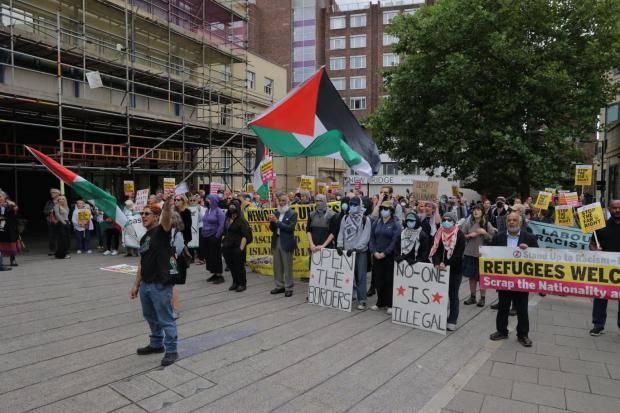
The last two months have seen weekly demonstrations across the UK called by a group calling itself the “great british national protest”, outside of hotels that the government uses to house asylum seekers. Fascist protestors have shown up in inconsistent numbers in Newcastle, espousing slogans like ‘stop the boats’ and ‘refugees not welcome here’, displaying symbols ranging from union jack flags to totemkopf t-shirts.

Counter-demonstrations have also been called weekly by Stand Up To Racism and a broad antifascist coalition of members of other local left-wing groups. Red Storm Collective has attended these counter-demonstrations in Newcastle. Our aims going into these were primarily the defence of the hotel and its inhabitants, surveillance, and intimidation of fascist protestors. 

Members of Red Storm Collective attending the first counter-demonstration outside of the Newbridge hotel, currently being used by the state to house asylum seekers.

To what extent these aims were possible was not only determined by left-wing and fascist forces, but also by the state. We expected to play a bigger defensive role than we have done. Instead, a large number of police assembled outside of the hotel entrance, keeping fascist protestors a significant distance away from the hotel. On the ground, the defender of the hotel was the state. To be clear, the state does not assume this role out of concern for its inhabitants, but out of a desire to protect state interests, ultimately concerning the protection of property, and the detainment and economic control over refugees. A large police presence has meant we have been restricted to our surveillance aim, which, while broadly successful, has demanded a reevaluation of our aims and strategies.

The role of the police has so far been to prevent direct confrontation between fascists and antifascists. Nowhere was that clearer than September 27th. Antifascists assembled near the fascist march with the intention of stopping it in its tracks, and were immediately kettled by police. While police redirected the fascists through the city on an alternative route, those of us still kettled were brutalised while trying to break out, suffering injuries and arrests. Arrestees were detained until the fascist march was over, and released without charge. For further details, read this account of the events of September 27th by another Red Storm comrade.​​​​​​​

The counter demo on the 27th went very differently to the previous counter demos at the hotel. The difference was that, while our aim of hotel defence aligned with the police (despite our conflicting motives), our aim of stopping the fascist march along our streets on the 27th put us in direct opposition to the state.

The fascists love to accuse the state of being left-wing, of ‘two-tier policing’. The 27th saw evidence to the contrary, with police violence directed entirely towards the militant left, resulting in four comrades arrested and many more injured. This must be exploited to make explicit our anti-state position. On the day, police acted as escorts to the UKIP-led demonstration, calmly walking alongside the racists through Newcastle city centre along a visible, city-centre route given to them by the state. Make no mistake, even with the diversion we created, the state had no intention of preventing this march.

It is not contradictory, however, to also say that the fascists are not allied with the state. Although, on the 27th, it was in the interest of the state to protect the march, the ultimate goals of the fascists differ from those of the state. In many cases, fascism is repressed by the state, such as by the heavy policing and prison sentences faced by racist rioters last summer.

Fascism is not willed by the bourgeoisie, but imposed upon them. We must move away from viewing fascist movements as a militarised wing of the capitalist state and towards viewing it as revolutionary, in the sense that it is both anti-state and anti-police, and wishes to restructure the class system according to their ideology1.

We have to recognise, and incorporate into our strategy, the tacit cooperation we enter into with the police in situations like the hotel counter-demonstrations. The suppression of fascism in Newcastle at recent counter-demonstrations should not be considered a victory, because it was achieved through reliance on the state. This is precisely the reason why we must present both revolutionary anti-fascist and anti-state politics. Anti-fascism must not be content with the easy victory of providing a visible, peaceful opposition to fascism. Rather, it must provide a revolutionary alternative to both the state and to fascism. We must remain steadfastly anti-imperialist in the face of both fascist and counterinsurgent liberal forces on the left that simply want wealth in the hands of the British working class at the expense of the global proletariat. Without anti-state, revolutionary politics, we hand strategic victory to the fascists, as they are then the only side presenting an alternative to bourgeois capitalism.

1.  Fascism & Anti-Fascism (Don Hamerquist) – Kersplebedeb. Available from: https://kersplebedeb.com/posts/fascism-anti-fascism-don-hammerquist/ ​

Posted in DiscussionTagged anti-fascism, Anti-Police

Bulletin: Nique la Police: state violence protects fascists

Posted on October 1, 2025 - October 1, 2025 by RedStorm

The following is a bulletin by a Red Storm Collective member on a recent anti-fascist demo which took place in Newcastle Upon Tyne:

The 27th of September saw three demonstrations in Newcastle city centre. On Quayside, the fascists mobilised from 13:00 and just up the road from 11:45 a coalition of local anti-fascists led by the North East Anarchist Group (NEAG), comrades from Red Storm and the Revolutionary Communist Group (RCG) gathered to block their route. At Monument gathered the representatives of the middle-class, petty bourgeoise, and labour aristocracy: the established unions, SUTR’s creaking bureaucracy and Newcastle Unites.

Comrades at quayside were quickly kettled as police cut through the less militant sections of the crowd, while the fascists were on a less ideal route. There were brief skirmishes at the kettle but as the fascists approached the New Bridge Hotel around 13:30, the kettle dissolved. NEAG and Red Storm comrades led a procession up to the hotel to meet the fascists. All the while Newcastle Unites remained at monument, singing songs and having photo shoots with the mayor while the fascists marched only a street away, protected by an honour guard of riot police.

Four comrades were arrested that day. Many more brutalised. This was as a result of reduced numbers at Quayside and on our march from Quayside. Numbers are always safety; you can dissolve into a crowd easily but Newcastle Unites and their leader Shumel staged a distraction at Monument. The actions of comrades at Quayside meant that the fascists had to reroute their march on a less well-populated route. The actions of the misleader at monument meant a thousand or so counter-demonstrators sat useless. I am sure that Monument made people feel good, the struggle is not supposed to be a feel-good experience. The struggle is a fight for the future. Had the mass of people in Newcastle that day been rallied to Quayside, the kettle may have been broken, or not happened at all, and we may have been able to advance along Quayside to properly block the fascists. Of a similar ilk to the crowd at Monument was the strange, small ‘communist bloc’ called by the RCP which, as usual, sat holding their newspapers while comrades tried to break the kettle.

Saturday was a mixed experience. We saw success in even our disorganised tactics against a well-equipped and organised police force, breaking the kettle just for a moment. However, the lack of prior mass agitation was a hinderance for us. The crowds behind NEAG, RCG and Red Storm comrades didn’t know quite what to do to help and attempts to inform the crowd were resistant to our efforts. Furthermore, the crowds were generally drawn to monument, meaning that the people were split between the navel-gazing speeches of monument and the active attempts to block the fascists of coalition comrades at Quayside.

The way forward is clear to me: form a united front with a provisional committee, a commitment to extra-state, dual power construction, a commitment to agitational propaganda efforts and a minimum political programme to unite anti-imperialist forces across the north east to pose a challenge to state repression primarily and street fascism when and where it arises. One thing is certain too that we, anti-fascists of various stripes, outnumbered the fascists nearly 10 to 1. If not for the actions of the state, they would not have passed.

Posted in Bulletin

Bulletin: Victory but Exhaustion: UCU win strike

Posted on October 1, 2025 - October 1, 2025 by RedStorm

The following is a short bulletin from a Red Storm Collective member who was involved in the Newcastle University Student-Staff Solidarity Campaign during the 2025 UCU strike:

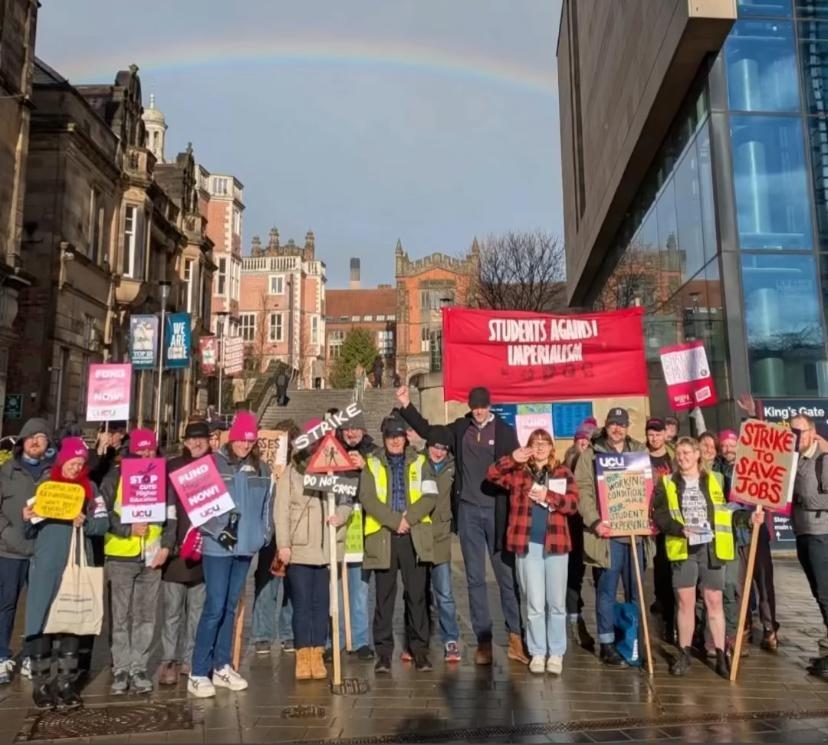
The UCU recently accepted a deal from the Executive Board (UEB) of the University of Newcastle. This ended the four-month long strike and accompanying student solidarity campaign. The strike saw a national demonstration, open meetings and the biggest picket lines Newcastle University had ever seen.

The strike began in February with the UEB having announced a round of cuts targeting 300 jobs this year and 150 next year. This first day of the strike saw the biggest picket ever on Newcastle’s campus, as well as a march to monument led by Red Storm comrades. From here the union took escalating strike action and the student solidarity campaign kicked off with an open meeting of over one hundred students who met to discuss the strike.

From here, the campaign became a marathon, with management attempting to wait out the union over the months of the strike. In the meantime, many unions came to the picket in solidarity with academic staff and students were a constant presence at the picket. The union made a great effort to present a united front and this paid off. The union accepted a deal to end the strike in May, winning no more redundancies this year or next. The committee also faced the possibility of rebellion over the deal, which allowed management lots of ways to break the agreement.

The strike was a long and hard effort on the part of the union and the student campaign. The committee believe the student campaign was vital to their victory, in showing the university united against the executives. The students faced a lack of division of labour on their side however, causing the length of the campaign to lead to exhaustion of the organisers. This is evidenced by the lack of engagement from the wider student body. There was not time enough to make an effort to connect students and staff and therefore the campaign suffered.

Issues with opportunist elements of the left also presented problems. The allegedly Revolutionary allegedly Communist Party (RCP) were frequently in attendance with their papers, seeking recruits among students despite their insistence that they were not. The legacy of the SWP was also palpable in the campaign with many members of the union, lacking the imagination to strike out from the bounds of what would be a ‘normal’ round of industrial action. The staff campaign was vigorous but dry and stodgy, which contributed to a lack of support for the students outside of the committee and the unusually engaged School of English. In short, the strike was won and won well, however, there was not the space or innovation within the established unions as they currently exist and nobody really knew how to handle the extra-union organising of the students, probably the students most of all.

Posted in Bulletin

Recent Posts

  • A response to ‘Notes on Fascism and Anti-Fascism’
  • The Necessity of Factionalism
  • Notes on Fascism and Anti-Fascism
  • “Claim no easy victories”: tacit cooperation and presenting an alternative to the state
  • Bulletin: Nique la Police: state violence protects fascists

Recent Comments

No comments to show.

Archives

  • February 2026
  • December 2025
  • November 2025
  • October 2025

Categories

  • Bulletin
  • Discussion
Proudly powered by WordPress | Theme: micro, developed by DevriX.