
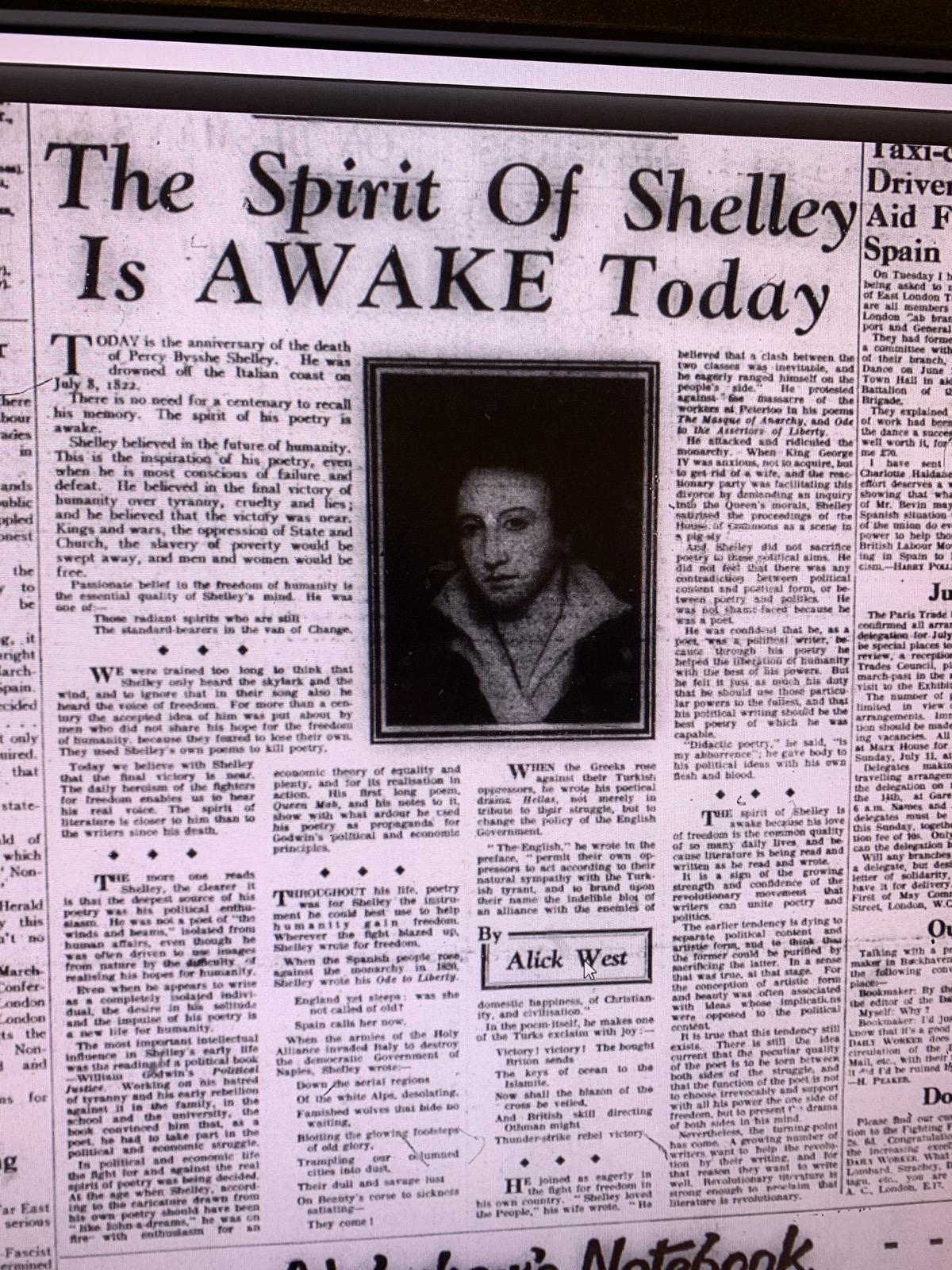
An article written on the occasion of the release of five of the Filton 24
Many of my comrades know that I am enthusiastic, more accurately fanatic, about the Romantic poet Percy Bysshe Shelley. The poet has been a mainstay of the literary and aesthetic culture of the British Left since his own lifetime with the publication of pirated copies of his Queen Mab. I, for instance, have quoted the last stanza of his poem The Mask of Anarchy in a few speeches. There are certain similarities between his time and ours. Particularly so now with the release of five of the Filton 24, who had previously been held with out trial or conviction for the past 18 months. I would like to offer a brief overview and an analysis of where it went for Shelley and where we might be going.
As briefly as it can be surmised: Shelley was born three years into the French Revolution, roughly a month and a half before the foundation of the first French republic. He seems always to have been a political radical. Paul Foot, of the SWP, calls Shelley a Leveller, after the faction of Cromwell’s army, where I would argue he is closer to Robert Owen or Saint-Simon, two of Shelley’s contemporaries. He was famously expelled from University College Oxford for the first piece of atheistic literature published in English. From there, he would go on to live a near nomadic life and drown in 1822 in the Bay of La Spezia. Shelley’s life was defined by his politics, constantly on the run from Home Office spies while in England and writing his critique of his present state in verse. His writings were unpublishable in his lifetime, broadly speaking, for their allegedly seditious content. The administration of Lord Liverpool, terrified of an English uprising like that of the French Revolution, had suspended Habeas Corpus and, more importantly, restricted the freedom of the press drastically. Richard Carlile, a publisher thought to have corresponded with Shelley, and Leigh Hunt, a publisher and friend of Shelley’s, had both been imprisoned for their publications. Most publishers did not themselves want to suffer for the sake of Shelley’s poetry.
Then came August 1819. At St Peter’s Field in Manchester, a crowd of perhaps as many as 100,000 gathered to demonstrate for suffrage. The crowd contained many women and children, and they were charged by the Royal Manchester Yeomanry. 18 were murdered and hundreds injured. This, and other responses of the government to the French Revolution, had a drastic effect on British political life. Previously, publishers were unwilling to publish radical texts or anything critical of the monarchy, such as Shelley’s The Mask of Anarchy, after the government had murdered its people at Peterloo. The Prince Regent, later George IV, and all government ministers lauded the soldiers who had charged and killed the reformers.
It would be useful to read some poems of Shelley closely. For instance, Song to the Men of England begins: ‘Men of England, wherefore plough / for the lords that lay ye low?’. In this line, Shelley says directly to the workers of England: why do you work for the people who oppress you? Later in the poem, Shelley asks, having discussed the real conditions of the working class in England: ‘Have ye leisure, comfort, calm, / Shelter, food, love’s gentle balm?’. In these lines, Shelley again begs the reader, or listener as this is one of Shelley’s ‘political songs’ composed in late 1819, to question if any of their work has been worth its fruits. Shelley asks as agitation, saying again: ‘What is it ye buy so dear / with your pain and with your fear?’ The poet highlights the inequality of capitalist social relations and the contradiction between the socialised nature of labour and the privatised nature of profit. The worker can only buy with their pain, fear and toil, despite this the narrative of the poem lays out that they have nothing to show for this – not even calm. Shelley stops short of explaining what it is we must do, but we know which way the resolution to that contradiction lies.
The reform or revolution message of the Peterloo massacre, and the poems Shelley wrote in response, is clear: capital is willing to kill you, kill it first. This has been made evident today with the recent hunger strikes by political prisoners on remand for actions carried out by Palestine Action. Five of these 24 were granted bail, following being found not guilty on the 4th of February, and released from prison. From October last year, eight of the Filton 24, who were on remand, held a hunger strike that only ended in January of this year. The message is clear: capital wants you dead if you threaten it. This bears repeition in our time as Shelley did in verse: kill capital or it will kill you. Both governments, Lord Liverpool’s and Starmer’s, are representatives of their classes – the alliance of bourgeoise and aristocratic landholders and the Bourgeoise and the rapidly proletarianising Labour Aristocracy respectively. The cavalry at Peterloo were the sons of rural landowners and Starmer is the servant of dwindling imperial super profits. These are both instances of naked class warfare, previously hidden but now on awful display.
There are further parallels between the Liverpool and Starmer administrations. The arrest of anti-government publishers and the mass arrest of pensioners at Defend our Juries protests. The use of mass spy networks to weed out radicalism and Shabana Mahmood’s proposal for a panopticonic policing system, replete with AI. At the start of the 1800s, the Duke of Norfolk, a prominent Whig MP and reformer, was toasting to a republic, two decades later and reformers were being murdered.
At Peterloo, the reformers met to demand the right to the vote and they were slaughtered for it. The hunger strikers have come so close to death that they could feel its breath and have all suffered life-long damage. These are just two moments where the face of capital shows. The true nature of the capitalist system’s coercion is unveiled, we are free but by necessity must submit ourselves to capital. We have left to resolve a contradiction left to us from Shelley and Luxemburg, reform or revolution. Where The Mask of Anarchy errs, calling for both peaceful demonstration but ‘ris[ing] like lions’, we must be certain like Luxemburg.
Shelley can serve as an important tool. His verse falls somewhere in the middle of the agitation-propaganda distinction and that is useful for us, to throw off the veil of ideology that hides capital in poetic language would be a great boon to the cause of the workers of the world. What Starmer and Liverpool both do in their repressions is use ideologies of ‘law and order’ or ‘seditious libel’ to obscure real class relations in language of decency and peace. In writing so early into the development of capitalism, Shelley critiques the underlying contradictions of fundamental capitalist social relations – of worker and parasite, toiler and capitalist. Shelley uncovers the tyranny of bourgeois government and an anarchy of capitalist production, then and now, and he poses a critique to the ideological structures that keep capital afloat. Verse, when read aloud, is a potent tool for conveying ideas and revolutionary verse such as Shelley’s is indispensable to us in the struggle.
In Shelley’s day, however, the poet didn’t see much popularity. It was not until after his lifetime that his poetry found truly mass appeal. The contradiction of Shelley’s time sharpened until in 1832, the great reform act was passed. This act expanded the franchise to the middle-classes: the shopkeepers, middle peasants and small landowners. Despite being fought for by the working-class and not granting the working-class the vote, the act was hailed. We have many more destructions to get through and when we are through we cannot accept, as Britain did in 1832, any step forward beyond a great leap. The contradiction exposed by Shelley in Song to the Men of England is unresolved, ours is that task as it was his. If Lenin lives, so does Shelley. The contradictions of our time are sharpening too. Independent working class political power is a solution Shelley could not have seen but we can mobilise his poetry for that purpose.
Solidarity forever from Shelley’s strongest soldier,
– Steve
Further reading:
Christopher Caudwell, Romance and Realism, (Princeton, NJ: Princeton University Press, 1970)
Paul Foot, Red Shelley, (Sidgwick and Jackson, 1980)
Jayson Althofer, ‘”Trace your Grave”: the poetry of The Communist Manifesto’s grave-digger thesis’, TEXT: Journal of writing and writing courses, (July 2023), pp. 2-15
Michael Fischer, ‘Marxism and English Romanticism: The persistence of the Romantic movement’, Nineteenth Century Contexts, 6.1, pp. 27-46