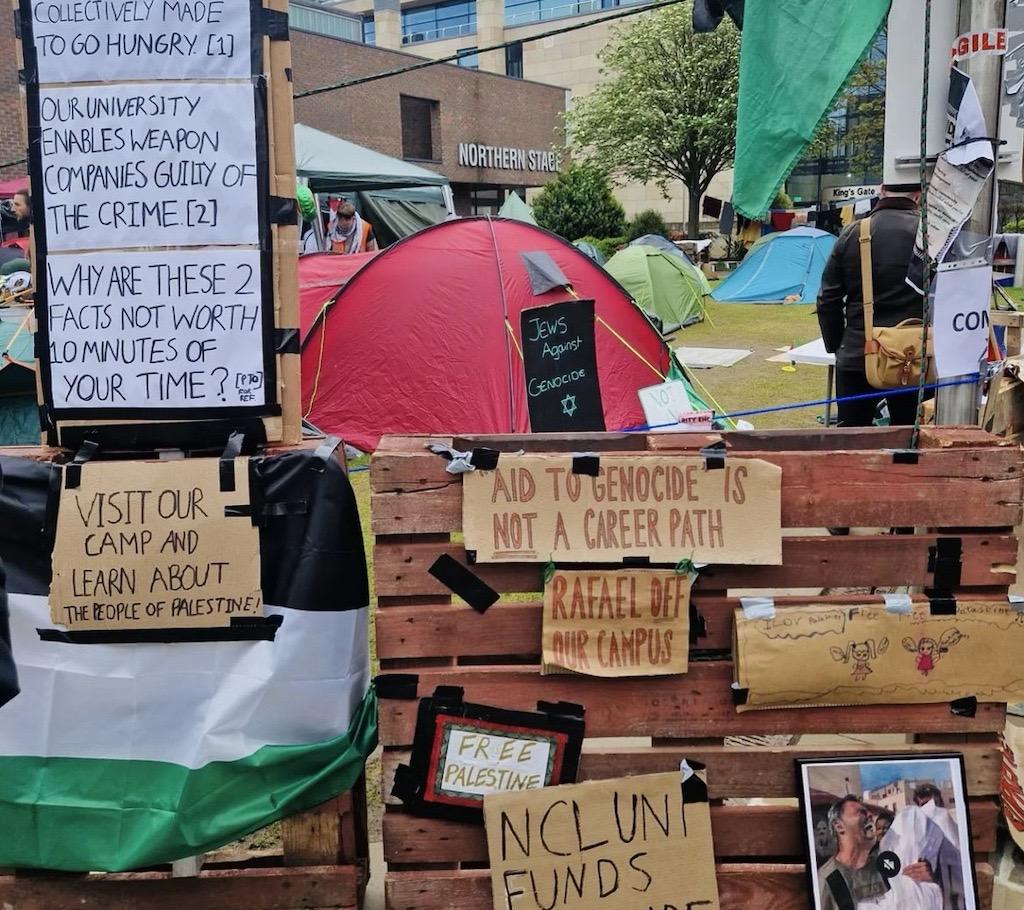
The following is a brief commentary on eight interviews carried out from October to December of 2025. At the time of publication, it is two years since the general upsurge of the so-called ‘Student Intifada’ and its spread from the United States to the United Kingdom. These interviews seek to explore the experience of the ‘Student Intifada’ in the North East of England, primarily Newcastle, which began following the Zionist Entity’s mass slaughter in Gaza and escalated to an encampment on May Day 2024. The interviewees are, generally speaking, old comrades of mine from those days. This is a methodological flaw as it has limited the pool of interviewees to people I know personally. The interviewees, and anyone else mentioned in their interviews, have had their names changed for reasons of anonymity. These interviews are intended to do a number of things. Firstly, to preserve the experience of the encampment, as those who were in their first year of university during the encampment are now coming to the end of their third year. Campus is then almost entirely empty of the cohort who lived the encampment, and as such it is important to keep a record of an experience that only lives in the most fleeting, fragile form – the digital. Secondly, to examine the encampment from a wider vantage point, rather than from solely my vantage point as my previous piece, The Necessity of Factionalism, does. Finally, to provide a close look at the student as a class and to understand the students’ revolutionary potential – or lack thereof. This last one is something that will need much more elaboration: a ‘student question’ with its own exploration and answers. These interviews, and the conclusions we can glean, should help in the process of understanding just how much we can call it a ‘Student Intifada’. In other words, can call that wave of protest a revolutionary uprising against Imperialism or must we call it as it might be – the bleeding-heart bleeding once more? This piece should serve as an introduction to a full reading of the interviews, which should allow for a more detailed analysis of the political and class composition of the ‘Student Intifada’. These are the initial set of questions I went into the interviews with, though I did ask follow-up questions as can be seen in the transcripts.
- Could you elaborate on your age now and at the time of the encampment as well as a general political descriptor of yourself?
- When did you first go to the encampment?
- What drew you to the encampment and what was your first impression?
- How did you spend the majority of your time at the encampment?
- How did you interact with the factionalism on the encampment?
- Can you describe your experience of King’s Gate-gate?
- Can you describe your experience of al-Shifa Hall?
- Can you describe your last experience with the encampment?
- What is your defining experience of the encampment?
- What have you been engaged with since the encampment? And what lessons have you taken from the encampment?
In reading these interviews I think it would be good to keep a handful of things in mind. The first and foremost of these, in my opinion, is that we must make an effort to uplift and support women in the sphere of revolutionary politics. I say this not in a paternalistic tone but rather than men need to shut up and pick up some rubbish once in a while. The pattern you will no doubt notice in reading the interviews is that at the encampment, it was generally the womenwho were left to the basic maintenance of the encampment. In short, the basic tasks of reproducing the encampment as a space were conducted by women. If we truly want to build a new world, there are the practical elements: yes, we cannot have a revolution if we can’t even wash the dishes as Comrade 3 puts it. However, more importantly, if you stand for the abolition of the present state of things, you must make an active effort to ungender labour. The invisible or uncredited labour of women facilitated the resistance at al-Shifa hall and other direct actions, it fed everyone I interviewed. As part of abolishing the present state of things, we must bring that labour into the light and perform it all together. We owe it to the women of our movement to work harder to dismantle old social relations. It is also important to keep in mind the vital necessity of criticism/self-criticism and furthermore of ideological struggle. Far too many of the issues of the encampment can be summed up as: people didn’t want to have that talk or people weren’t willing to just hash it out. You will always need the struggle session and to shy away from struggle, ideological or the direct fight with capital, is a kind of liberalism that must be choked to death. Lastly, a word on the title: this is a quote from my ninth interview that we had trouble getting from the interviewee as it was recorded on their phone. As a result, I have not been able to transcribe and present it with the rest of the interviews. This is a real shame as, as you can no doubt tell from the title, it was full of passion and sharp insight. The title is intended to show the strength of those immense convictions that ran through the encampment as a whole and, further than that, the willingness to take international solidarity as far as you can go with it. Though, this also marks an unmistakeable irony; we achieved neither victory nor martyrdom nor very much at all but we are going on nevertheless.
A Luta Continua,
– Comrade Steve.