This work is a critique of the position as expressed in the Notes on Fascism and Anti-Fascism (https://redstorm.noblogs.org/2025/11/67/) though I was not present for the discussion which produced these notes. There are many issues with the position as articulated. Some or all of what I write may be a response to the articulated position rather than the actual position, that will unfortunately be a consequence of my not being present for the discussion that produced the Notes on Fascism and Anti-Fascism. Further, I take issue with the way this position has emerged, seemingly not through the living, breathing, present struggle but rather from various disparate writings.
Issues of Methodology
There are some issues of method in the current collective understanding of fascism. To begin with, the position seems less an understanding of fascism and more a synthesis of three thinkers that comrades read and find persuasive. However, to investigate properly something as complex and important to our understanding of the current situation, we cannot simply take from the works of people who can make persuasive arguments. We must remember and internalise Oppose Book Worship, and I appreciate the irony but ask you to bear with me. We cannot think, as Mao caricatured book worshippers, that ‘Whatever is written in the book is right’ because this is ‘the mentality of culturally backward Chinese peasants’. Simply because Hammerquist can write it poetically or Sakai can write it acerbically, does not mean that it is true or that the analysis is sound.
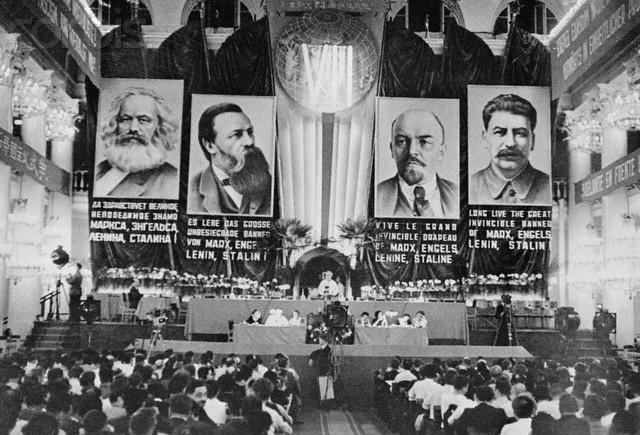
Furthermore, there has been an unjustified disregard for the lessons learned in the course of the struggle against previous fascisms. Most egregiously, the investigations and theoretical understanding of the Communist International are disregarded and framed in a disingenuous light. Fascism was not seen as a wing of the state but more akin to a crisis movement seeking to entrench and save bourgeois power when it seemed to come under threat. The militants of the Comintern are the voices that experienced the first fascist offensives and a proper understanding of them must be reached. To return to Oppose Book Worship, Mao identifies that to not have probed into the ‘present facts and past history’ of a situation means to not have investigated in the slightest. We must understand the past of anti-fascism and the lessons that they have learned in order to combat and understand fascism in the present. We have things to learn from G Dimitrov (this is not to say you should carry out Dimitrov’s recommendations on strategy and tactics) and R Palme Dutt, who spent decades fighting and understanding fascism. We cannot so stubbornly refuse to learn from them. If their conclusions are wrong, we will find that there conclusions are wrong by investigating fascism as it is reborn in front of us not by reading what other people have theorised about fascism. At the same time, it is inadequate to read only these figures of the first fascist offensives or to read both the new and the old. No book or theoretical work can contain the struggle.
On a similar note, there appears to be a misunderstanding of the Comintern’s position on fascism. It was not seen in the slightest as ‘almost beyond capitalism’, it was seen as the sincerest face of capital. Fascism was not also seen as a wing of the state by any means. Fascism and social democracy were the right and left wings of capital, which is a reductive position in and of itself. The definition of fascism as the Comintern put forward is, to quote from a resolution from the seventh Comintern Congress in 1935: ‘the open terrorist dictatorship of the most reactionary, most chauvinist and most imperialist elements of finance capital’. While this definition has problems that it is beyond the scope of this piece to address, it is still a vastly more accurate definition. We can see that the Comintern believed fascism to be authentically capitalist, inexorably linked with imperialism as capitalism’s highest stage and fundamentally based in protecting capital which figures like Dutt go about proving. Additionally, the Comintern did not really advocate for alliances with just anyone who opposed fascism. The policy, misguided as it was from Dimitrov, was the creation of a united front of the revolutionary representatives of the industrial proletariat, i.e. trade unions, youth leagues, working-women’s organisations, upon which could be built a popular front of all anti-fascists who would stem from other classes. The popular front, of course, involved collaboration with social democrats, conservatives and liberals. This was and is only situationally useful and we should not right now engage in popular front work. In France though, for instance, their popular front ended up stabilising capital and I am sure its modern incarnation will too. In Germany, however, the popular front tactic may have prevented Nazism coming to power but this would likely have involved some form of compromise with reformist elements.
The solution then is to investigate fascism as it comes before us. To examine Nazism, Falangism, classical Fascism and the modern fascist offensive in terms of their history, their present class composition and what we can perceive of their strategy. We must come to an understanding of the class composition of past and present fascisms. One of the few ways to examine bullshit closely, however, is to sit in it. We must interrogate each fascist offensive in its entirety and inquire into its class composition by going into fascist spaces and understanding the material needs and conditions they are responding to. We must also examine fascism as a movement that seeks to be given, not take, state power. Hitler was handed the chancellorship when the votes of the Nazi party were declining. Mussolini’s “march” on Rome was a piece of political theatre: King Victor Emmanuel III had already given him the prime ministership and Mussolini arrived to Rome by train to coincide with the arrival of his marching foot soldiers. Fascism historically cannot be said to be revolutionary when the bourgeoisie give it power time and time again. Furthermore, the bourgeoisie do not often give power to anyone who will truly challenge their ownership of the means of production. This seems to continue to today with Trump becoming Statesian president in legitimate elections twice. State power is very rarely taken by fascists because fascism is an organ of the current order, i.e. the dictatorship of the bourgeoisie, and historically it is more likely to find itself given power. When liberalism needs to tap out, fascism taps in; democratic rights are curtailed and capital shows its true face.
Lastly, there doesn’t seem to really be an interrogation of the concrete social relations of fascisms past and present. The question as to the class composition of fascist movements remains unexamined in the Notes. The question of how fascisms function seems to have been reduced, in some quarters, to does a bad thing occur rather than looking at how fascism, by and large, has remade the supports around the dictatorship of the bourgeoisie in times when that dictatorship seems to lie on shaky ground. Palme Dutt says that this is the bourgeoisie seeking to head off proletarian revolution, a kind of mirror revolution to draw on C Caudwell, where fascism poses itself as revolutionary but rather strengthens and enshrines social relations. The goal of the revolutionary movement must be the abolition of these social relations.
Things without real issue
I do not entirely disagree with the Notes however. Below are some elaborations on the things that I do not find objectionable.
The critique of the popular front as a long-term strategy is a fair and correct one, as I have touched on, we cannot compromise with reformist trends and wish to tear down the social relations that define capital. Additionally, working with any kind of reformist elements of the left and any liberals will always lead to the strengthening of capital and nothing more. Fascism is a defence mechanism, a knee-jerk reaction, to a crisis where capital might come under direct threat. We can’t work with capital’s other leg, the liberals and reformists, because it is part of the body of capital. We will be outnumbered by the liberals and the reformists and so to work with them is, in fact, to dilute ourselves. We must rather engage in mass work and work with revolutionary elements.
Fascism is a system of fancy. If it is comparable to anything left-wing, it would be the utopian socialists in that they believe or rather profess to believe that their movement can and will meaningfully challenge the class system. In both cases, this is illusory and that recognition of fascism’s illusory promises is paramount.
Fascism is also undoubtedly rooted in machismo. It’s in every poster of the big aryan specimens standing very closely as compatriots. The big and capable aryan man who promises to smash bourgeois decadence but ends up licking bourgeois boots. Though I would argue this machismo enters into homoerotic territory, with male-male relationships being the only viable source of social capital as a woman is simply a piece of property by which you can make more workers and you can’t have a meaningful relationship with a piece of property, in the fascist conception. The illusory nature of fascism’s promises allows the machismo to coexist with alleged feminism, see TERFism and the pink ladies, fascism promises to ‘protect’ women as a political class but in actuality enshrines the social control of women by men.
Broadly as well fascism is not really a conscious creation though when it arises it is more often than not consciously utilised. Fascism arises fairly organically, historically speaking. Falangism for instance has deep roots in the Catholicism of Spain and the institution of the Catholic Church has a rich and storied history of promoting authoritarianism in countries where it is the majority, even before the era of imperialism and the emergence of fascism, the two of which are inexorably tied. Before Nazism took power in Germany and well before the NSDAP was founded, there were a hundred, hundred small fascist, semi-fascist or proto-fascist organisations. There were the monarchists, there were the volkish nationalists, there were civic nationalists, there was Japanese-style militarism-fascism, there was the erstwhile enemy of Luxemburg and Liebknecht: the Freikorps. These movements arise in moments when bourgeois power seems fragile, the civil war in Spain or the long decade and a half of revolutions, putsches, failed soviets and street violence following WWI in Germany, and when one seems to find purchase as a mass movement, most others fade away.
Issues with the conclusions
Firstly, fascism itself purports to being that revolutionary 3rd position described in the notes on fascism. I am deeply suspicious of any position that comes to the same conclusions about fascism that it preaches about itself. Why, pray tell, are we seeming to take fascism at its word? Much of what fascism purports to being and says it will enact are not really anti-capitalist measures but rather a trick, wool pulled over the eyes, to gain mass support. Nowhere has fascism sought to or actually has dispossessed the bourgeoisie of their power and always has fascism come to power with the explicit support of a least a section of the bourgeoisie that has then gone on to profit immensely from fascism’s gaining state power. For instance, in Nazi Germany the use of the slave labour of the ‘undesireable’ populations of Europe was prevalent and represents a transformation of our relation to the bourgeoise, but not a transformation of their relation to us or their relation to the means of production. The vampiric nature of capital hasn’t changed or lost the ability, power or position to feed off labour, it is simply that labour is kept in rather heavier chains than before. The concrete social relations were not upended, capital simply facilitated more efficient extraction of profit.
I will concede that capital ceded some state power in the case of Nazi Germany however because capitalist social relations remained under Nazi rule then a transformation of the system cannot be said to have happened. It must be remembered that control and ownership are two incredibly different things. The Nazis undoubtedly strove for autarky but this looked in reality like working with large business concerns to direct them to gain more profit. At no stage of this process did ownership over the means of production change hands or did capital change its relation to labour. It is a rather analogous process to the process by which the labour aristocracy forms under the leadership of a reformist wing, for instance Britain in the post-war period throwing up the welfare state was a shield for capital against the workers’ movement strengthened during the war. The threat of proletariat revolution seems so imminent in a period of intense crisis that capital is left with two options, the mean one (fascism) and the nice one (reformism). Fascist anti-capitalism is about as sincere in its anti-capitalism as Social Democracy, by which I mean that they both are not.
Fascism is the ‘break in case of emergency’ of imperialism-capitalism when reformism seems impossible, revolution around the corner and capital must uplift a section of the dispossessed population to be its mercenaries and protect its power. To return to the instance of Nazi Germany, many of the brownshirts and SA came from a proletarian background while the leaders and members of the SS came from a petty bourgeois background, for example Adolf Hitler’s father was a tax collector in the Austrian Empire. On the SA, they were purged almost as soon as the Nazis took power because capital with it’s fascist face on does not suffer the organised proletariat uncontrolled and the SA were notoriously unruly. However, their promises of the rebirth of the nation with the elimination of decadent capitalism was false and was not borne out materially in the slightest. The big business concerns remained but it was only the Jewish CEOs who had their wealth expropriated. The most that happens under fascism is the uplifting of a handful of the dispossessed and downwardly mobile to the status of running dog.
Secondly, the white working-class does not have really all that much to gain from fascism. Ideologically, it sure seems like it but fascism is always illusory, it is a mirror revolution that, in claiming to defeat capital, erects a wall and moat around it. Fascism obscures capital’s power behind notions of the race and the fatherland but keeps capital nice and safe. Race is often just the hat capital puts on to hide itself, to try to obscure class differences and keep itself intact. In the instance of Falangism in Spain, the Spanish people were all Spaniards, all Catholics under Falangism which said ‘you don’t need to do anything rash in front of The Holy Virgin, do you Mr Worker?’. Fascism heads off proletarian revolution by making running dogs of some of the dispossessed but the whole of the dispossessed cannot be lifted up at once and as a whole. There are only so many low-level bureaucrats and soliders that fascism needs and as a result fascism cannot challenge bourgeois power because to challenge bourgeois power means, necessarily, to seek the liquidation of class. This is the class basis of its constant drive to war, ideologically you must ‘fight for the fatherland!’ and materially the mercenary class of capitalism is strengthened and given purpose. Fascism must be a hive of activity, a frantic drumbeat. It must always be active, fighting this enemy or that, so as to give its running dogs something to chew on. Being imperialism’s running dog is all well and good, until you remember you are still a dog and start having the compulsion to get the fucking collar off. Fascism seeks to safeguard capital’s power by uniting any elements that could challenge it, telling those subversive, dispossessed elements that there’s a national rebirth that needs midwives not the birth of the communist world.
Lastly, there does not seem to be a recognition of the mass work that is needed to combat fascism. There are brief mentions of an ephemeral left-right political basis but these are not classes who have concrete relations to the means of production. We must ask what are the classes we are mobilising? Who are they? Where are they? What work do they do? How are they sociall composed? Are they politically composed? This is not the work of a few and isolated cadres but a broad struggle happening up and down the country. It is not enough to appear revolutionary, to appear to be anti-state. We must engage the masses, learn their needs and propose revolutionary solutions.
All this together then: fascism is the defence mechanism that arises in contrast to communism, anti-imperialist movements and the revolutionary self-organisation of the proletariat at a period where capital appears threatened, by financial crisis, national liberation movements or whatever else. Fascism may put on the face of anti-capitalism but that’s not quite real, this is never its true face. If fascism were to show its true face, you wold inevitably find capital. It seeks to shore up and defend capital and if that means, cedeing minute amounts of power, getting very racist, throwing the dispossessed of a particular country a treat now and then or any other number of sheets it can throw over capital then it will do that. This is the transient, ephemeral nature of capital; it will put on whichever hat it likes to keep capital in power at a period of crisis. In seeking to shore up capital, fascism must also protect certain social hierarchies necessary to the production and reproduction of capitalism-imperialism as a world system, gender most obviously in our period of intense transphobia on these green and pleasant TERF Islands.
Fascism is an organ of bourgeois dictatorship trying to tell you that it is not and the position as articulated in Notes on Fascism seems an incoherent one that does not develop our understanding of fascisms past or present. Rather it seems to have muddied the water.
Solidarity forever,
– Comrade Steve